

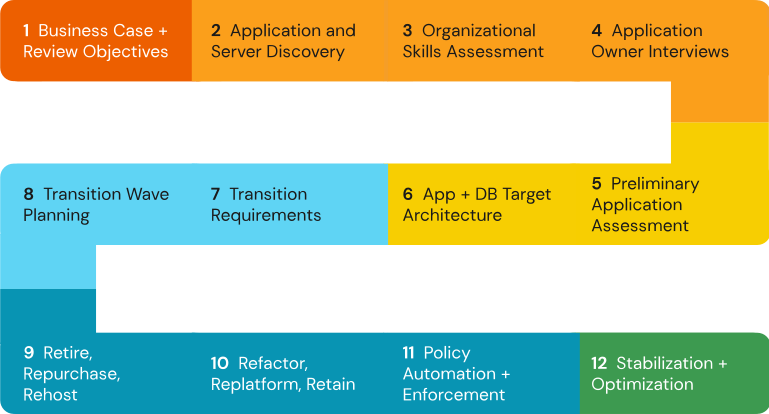
What a cloud readiness assessment must decide
A cloud readiness assessment is not a server inventory, questionnaire, or one-time readiness score. It is an evidence-backed decision process that connects business objectives, applications, dependencies, technology, costs, risks, organizational readiness, modernization opportunities, and AI-adoption potential to a practical transformation roadmap.
The assessment must answer four questions for every application in scope:
- Should the application change? Is there sufficient business value in moving, modernizing, replacing, or retiring it?
- Which outcome is appropriate? Migrate, modernize, replatform, replace, retire, retain, optimize, or prepare for AI adoption?
- What evidence supports that decision? Dependencies, costs, risks, constraints, and business context - not opinion.
- What will it cost, what value will it create, and when should it happen? A defensible business case and a dependency-aware sequence.
A 2026 assessment must also answer a broader question:
The question is no longer simply “Can this application move to cloud?” The better question is “What is the best future for this application, and what business value can migration, modernization, or AI adoption unlock?”
This guide sits in the Decide phase of the Tidal Enterprise Modernization Methodology™. The methodology is built on a simple premise: one methodology, multiple transformation outcomes. Whether you are migrating to the cloud, modernizing legacy applications, adopting AI, or optimizing an existing environment, the first steps are always the same: understand your application portfolio, assess opportunities, build a business case, and execute with confidence.
flowchart LR
 A[Discover<br/>Enterprise Intelligence] --> B[Decide<br/>Cloud Readiness Assessment]
 B --> C{Outcome per application}
 C -->|Migrate| D[Deliver<br/>Migration]
 C -->|Modernize| E[Deliver<br/>Modernization]
 C -->|Adopt AI| F[Deliver<br/>AI Enablement]
 C -->|Replace| G[Deliver<br/>SaaS Replacement]
 C -->|Retire| H[Deliver<br/>Retirement]
 C -->|Retain| I[Retain<br/>No Change]
 C -->|Optimize| J[Deliver<br/>Optimization]
Why cloud readiness assessments fail
In practice, we see assessments fail for predictable reasons. The failure modes below come from real delivery experience, not generic checklists.
- Incomplete inventory. The assessment starts from a CMDB or spreadsheet that is missing applications, owners, or dependencies. Decisions made on an incomplete portfolio produce rework when hidden dependencies surface during execution.
- Infrastructure-only discovery. Teams inventory servers, storage, and network but skip applications, business ownership, and dependencies. The result is a list of machines to move, not a portfolio to transform.
- Migration treated as the only valid outcome. Every application is scored for cloud suitability and routed to migration. Applications that should be replaced, retired, or retained are forced into a migration wave they do not belong in.
- Missing business owners and objectives. Technical readiness is scored without business context. Applications are migrated based on technical ease rather than business value.
- Undocumented dependencies. Applications are assessed individually. Cutover fails when integration points, shared data, and downstream consumers appear during execution.
- Weak cost baselines. Current operating costs are estimated, not measured. Cloud cost projections have no baseline to compare against, and the business case cannot be defended.
- Recommendations without evidence. A spreadsheet recommends “rehost” or “refactor” with no supporting evidence. The recommendation cannot be audited, challenged, or updated when conditions change.
- Ignoring modernization and AI opportunities. The assessment asks only whether an application can move. It misses the gains available from modernization, platform change, AI enablement, or retirement.
- Assessing applications individually while ignoring portfolio sequencing. Each application gets a score, but no one maps dependencies, shared platforms, or foundational work. Waves are built without dependency awareness.
- No path from assessment to funded execution. The assessment produces a report. It does not produce a funded roadmap, a business case, or a delivery plan. The work stalls.
- One-time assessments that become stale. The assessment is published once. Costs, dependencies, business priorities, and technology change within months, and the assessment is out of date before execution begins.
A defensible assessment is designed to avoid these failure modes. It starts with business objectives, gathers evidence with provenance, evaluates multiple outcomes, and produces a roadmap that can be maintained as conditions change.
Inputs to a defensible assessment
A defensible assessment depends on the quality of the Discover phase. See Discover, Decide, and Deliver in the Tidal Enterprise Modernization Methodology™ for how assessment fits the full program. The inputs below are the minimum evidence required to make consequential decisions.
| Input | What it covers | Why it matters |
|---|---|---|
| Business objectives and scope | Drivers, goals, constraints, in-scope applications | Without business context, technical scores cannot prioritize |
| Application and infrastructure inventory | Applications, servers, storage, network, platforms | The portfolio is the unit of decision, not individual servers |
| Dependency and integration evidence | Upstream and downstream integrations, data flows, shared services | Dependencies determine sequencing and cutover risk |
| Source-code and database analysis | Languages, frameworks, database engines, code health | Code and database constraints determine modernization options |
| Application-owner interviews | Business criticality, usage patterns, pain points, roadmap | Owners provide context that discovery tools cannot |
| Criticality, security, compliance, and data requirements | Availability, RTO/RPO, regulatory constraints, data sensitivity | Constraints eliminate outcomes or add prerequisites |
| Costs and performance | Current operating cost, infrastructure cost, performance baselines | Cost baselines make the business case defensible |
| Skills and organizational readiness | Team skills, operating model, support capacity | Readiness determines whether the organization can sustain the outcome |
| Modernization constraints and opportunities | Technical debt, architecture limits, modernization potential | Migration is not the only outcome worth evaluating |
| AI-readiness signals | Data availability, API readiness, workflow suitability | AI adoption is a possible outcome, not an afterthought |
| Evidence confidence and gaps | What is verified, what is assumed, what is missing | Confidence levels prevent over-claiming readiness |
For a portfolio of 500 applications, the manual approach breaks down because the evidence is collected in spreadsheets by different people, with no provenance, no consistent scoring, and no way to maintain it as conditions change. The output is a snapshot that is stale before it is published.
The assessment dimensions
A defensible assessment evaluates each application across the dimensions below. The goal is not to produce a single score but to produce enough evidence to choose the right outcome.
Business value and criticality
How important is this application to the business? What is the cost of downtime, the impact of degradation, and the strategic value of the capability it provides? Business value is the primary driver of prioritization. An application with low technical readiness but high business value is a modernization candidate, not a retention candidate.
Technical fitness and lifecycle
How old is the codebase? Is the platform supported? Is the application actively maintained or running on borrowed time? Technical fitness determines whether the application can sustain any outcome without remediation.
Cloud suitability
Can the application run in a cloud environment without material change? What are the constraints - licensing, latency, specialized hardware, data residency? Cloud suitability determines whether migration is feasible and at what cost.
Modernization opportunity
Would the application benefit from refactoring, replatforming, or re-architecture? What would change about its maintainability, speed, resilience, or cost? Modernization opportunity is evaluated against the same evidence as cloud suitability.
AI readiness and AI-adoption opportunity
Could this application support AI-enabled workflows? Is there a business use case, trustworthy data, API access, and an operating model to sustain it? AI readiness is treated as a Decide-phase intent, not a separate methodology. The same application portfolio should not be reassessed from scratch for every transformation goal.
Risk and complexity
What is the execution risk? How complex is the change, and what dependencies make it harder? Risk and complexity determine sequencing and whether a pilot is required before commitment.
Cost and benefit
What will the target state cost to run? What is the migration or modernization cost? What value is created, and over what period? Cost and benefit must be compared against a measured baseline, not an estimate.
Dependency and sequencing constraints
What must move first? What shared platforms, data services, or API gateways are prerequisites? Dependencies determine the order of execution and the boundaries of migration waves.
Organizational and operating-model readiness
Can the team operate the target state? Do they have the skills, processes, and support model to sustain it? An application that is technically ready but operationally unsupported will fail after cutover.
Outcomes and disposition decisions
A cloud readiness assessment does not produce a single “ready” or “not ready” verdict. It produces a disposition decision for each application, evaluated against the evidence above.
| Outcome | When to choose it | What it means |
|---|---|---|
| Rehost | Location change creates value, application is technically sound | Move to cloud with minimal change |
| Replatform | Target platform or managed service reduces operational burden | Move with targeted optimization, no core rewrite |
| Refactor / Modernize | Capability, maintainability, speed, or resilience must change | Re-architect for cloud-native or modern patterns |
| Replace | A commodity platform or SaaS better serves the need | Substitute with a commercial alternative |
| Retire | Value no longer justifies cost and risk | Decommission and consolidate |
| Retain | Current state is appropriate, change is not worth the cost | Keep as-is, document the decision |
| Optimize | Current architecture is appropriate but inefficient | Reduce cost or improve performance without migration |
| Prepare for AI | A grounded use case, data, and controls exist | Enable API access, data, and architecture for AI workflows |
| Defer | Evidence is insufficient or prerequisites are unresolved | Reassess after remediation or stronger evidence |
The assessment should not claim one outcome is inherently superior. A defensible assessment evaluates each application against multiple outcomes and recommends the one supported by the strongest evidence.
flowchart TD
 A[Application record with evidence] --> B{Business value high?}
 B -->|No| C{Still needed?}
 C -->|No| D[Retire]
 C -->|Yes| E[Retain or Optimize]
 B -->|Yes| F{Technical fitness adequate?}
 F -->|No| G{Worth modernizing?}
 G -->|No| H[Replace or Retire]
 G -->|Yes| I[Refactor / Modernize]
 F -->|Yes| J{AI use case + data ready?}
 J -->|Yes| K[Prepare for AI]
 J -->|No| L{Cloud suitable + cost justified?}
 L -->|Yes| M[Rehost or Replatform]
 L -->|No| N[Defer pending evidence]
What modernization and AI change in 2026
Cloud readiness is now an entry point into a broader transformation decision. A modern assessment identifies the gains available from:
- Reduced operating cost and infrastructure dependency - moving off owned hardware, licensing, and datacenter commitments
- Improved resilience, scalability, and delivery speed - managed services, elasticity, and automated deployment
- Technical-debt reduction - retiring unsupported platforms and modernizing codebases that block change
- Platform standardization and rationalization - consolidating overlapping applications onto shared platforms
- Faster product change and release cycles - cloud-native patterns that reduce lead time
- Improved data accessibility and governance - exposing data through APIs and managed data services
- API enablement and composability - making application capabilities available to other systems and AI workflows
- AI-assisted operations and software delivery - using AI to improve monitoring, incident response, and development
- Application and workflow redesign around AI capabilities - enabling AI use cases where data, controls, and operating model support them
- Identification of applications that should not migrate yet - deferring or retaining where change is not justified
This guide introduces modernization and AI as assessment outcomes rather than exhausting each subject here. The Enterprise Modernization Methodology™ explains how shared portfolio evidence supports multiple outcomes. For Decide-phase AI adoption, see the AI Readiness Assessment guide. When dispositions call for controlled cutover, the Migration Playbook covers Deliver-phase execution and change management.
Portfolio-level planning
A cloud readiness assessment that scores applications individually but ignores portfolio sequencing produces a list, not a roadmap. A defensible assessment produces a dependency-aware execution plan.
Grouping and waves
Applications are grouped into migration or transformation waves based on dependencies, shared platforms, business priority, and risk. A wave is a unit of execution that can be planned, rehearsed, and cutover as a coordinated change.
Dependencies
Dependency mapping determines what must move together. Applications that share data, integrations, or runtime platforms should be assessed and executed as a group. Undocumented dependencies are the most common cause of cutover failure.
Quick wins versus foundational work
A defensible roadmap balances quick wins that build confidence and momentum with foundational work - data platforms, API gateways, identity, and networking - that enables later waves. Foundational work is harder to fund because its value is indirect, but it is the prerequisite for sustained transformation.
Target-state constraints
Cloud landing zone, security baselines, compliance controls, and operating-model readiness are prerequisites that determine what can move first. A wave that is technically ready but blocked by landing-zone readiness is not ready.
Roadmap, governance, and funding
The output of the assessment is a roadmap with owners, costs, benefits, and dependencies. It must be governed - reviewed, updated, and funded as a program, not a one-time project. Approved waves then move into Deliver using the practices in the Migration Playbook.
Deliverables
A defensible cloud readiness assessment produces the deliverables below. A score without these artifacts is not sufficient.
| Deliverable | Description |
|---|---|
| Evidence-backed application record | Application, dependencies, code, database, owner, cost, and risk evidence with provenance |
| Readiness and risk findings | Cloud suitability, modernization opportunity, risk, and complexity per application |
| Disposition recommendation | The selected outcome per application, with supporting evidence |
| Estimated cloud costs and ROI | Target-state cost, migration cost, and projected benefit against a measured baseline |
| Modernization opportunities | Applications where refactoring, replatforming, or re-architecture create value |
| AI-adoption opportunities and prerequisites | Applications and workflows where AI enablement is viable, with prerequisites |
| Migration-wave or transformation-roadmap placement | Dependency-aware sequencing into waves with owners and timing |
| Executive roadmap | A funded, governed program plan, not a one-time report |
| Evidence gaps and next actions | What is unknown, what is assumed, and what must be resolved before execution |
Manual assessment versus Tidal Accelerator
Manual assessment with spreadsheets works for a small portfolio. A team of 20-30 applications with stable owners, consistent evidence, and a single assessor can produce a defensible assessment manually. Beyond that scale, the manual approach breaks down.
| Dimension | Manual spreadsheets | Tidal Accelerator |
|---|---|---|
| Consistency | Scoring varies by assessor and session | Consistent assessment across the portfolio |
| Evidence provenance | Sources are undocumented or lost | Every finding is traceable to source evidence |
| Portfolio scale | Breaks down beyond 50-100 applications | Designed for hundreds to thousands of applications |
| Repeated interviews | Owners are interviewed multiple times | Interview evidence is captured once and reused |
| Recommendation quality | Recommendations depend on the assessor | Recommendations are based on consistent evidence and rules |
| Cost modelling | Manual estimates, no baseline comparison | Cloud cost modelling against measured baselines |
| Dependency-aware planning | Dependencies are documented separately | Dependencies are part of the application record |
| Modernization and AI-opportunity analysis | Evaluated separately or not at all | Evaluated alongside migration as competing outcomes |
| Governance and reporting | Status is maintained manually | Executive reporting and governance artifacts are generated |
| Maintaining the assessment over time | Stale on publication | Evidence is updated as conditions change |
Tidal Accelerator is Tidal’s paid Enterprise Intelligence platform. It operationalizes the Discover and Decide phases of the Tidal Enterprise Modernization Methodology™ by turning enterprise data and stakeholder knowledge into Enterprise Intelligence, defensible recommendations, cost models, modernization opportunities, migration waves, and executive roadmaps.
Cloud readiness assessment checklist
Use this checklist as a framework. It is not exhaustive - every portfolio has unique constraints - but it covers the evidence required for a defensible assessment.
Business and scope
- Business objectives documented with measurable goals
- In-scope applications and environments defined
- Success criteria defined (cost, performance, risk, time)
- Executive sponsor and business owners identified
- Constraints documented (deadlines, compliance, budget, regulatory)
Inventory and discovery
- Application inventory complete with owners and criticality
- Infrastructure inventory complete (servers, storage, network, platforms)
- Dependencies mapped (upstream, downstream, shared data, integrations)
- Source-code and database analysis completed where relevant
- Application-owner interviews scheduled and completed
- Evidence confidence and gaps documented
Assessment dimensions
- Business value and criticality scored per application
- Technical fitness and lifecycle assessed
- Cloud suitability evaluated with constraints documented
- Modernization opportunity evaluated
- AI-readiness signals assessed where relevant
- Risk and complexity scored
- Cost and benefit modelled against a measured baseline
- Dependency and sequencing constraints mapped
- Organizational and operating-model readiness assessed
Outcomes and roadmap
- Disposition decision per application with supporting evidence
- Migration or transformation waves defined with dependencies
- Business case with cost, benefit, and ROI documented
- Executive roadmap with owners, timing, and funding
- Evidence gaps and next actions documented
- Governance and reassessment cadence defined
A downloadable version of this checklist is available as a PDF for offline use.
Proof and next step
Tidal has assessed and migrated enterprise application portfolios across more than a decade of delivery. The patterns below are drawn from real engagements.
Jackson National Life
Jackson National Life used a cloud readiness assessment to analyze their application portfolio and produce a data-driven migration and modernization strategy. The assessment identified 19% OpEx savings in the first year through optimized infrastructure and services, charted a path for migrating larger workloads, and recommended adopting cloud-native technologies like serverless to reduce costs. The assessment also identified further savings opportunities across Jackson’s broader portfolio and delivered a tactical roadmap to guide each phase of migration. Read the Jackson National Life case study.
TRREB
The Toronto Real Estate Board needed a deep-dive assessment to determine cloud readiness and identify recommended cloud-native architectures. Without the assessment, TRREB would have been limited to a lift-and-shift migration. The assessment identified the cloud-native services and platforms that yielded efficient deployments and lower licensing costs. Read the TRREB case study.
Statistics Canada
A national statistics agency assessed 50 mission-critical applications in under three months and managed 37 migration waves via code over an 18-month program. The engagement produced measurable outcomes including a 168x improvement in SAS server deployment time, an 87% reduction in critical job processing time, a 59% reduction in net server count, and greater than $2.6M in annual cloud infrastructure cost avoidance. The result was not a one-time report but a governed program of evidence-backed waves with measured outcomes. Read the Statistics Canada case study.
Next step
Whether you are facing a datacenter exit deadline, rising maintenance costs, or strategic pressure to adopt AI, a cloud readiness assessment is the first step. The output should be a funded roadmap, not a score.
- Assess your portfolio with Tidal Accelerator - operationalize Discover and Decide with consistent evidence, provenance, and governance at enterprise scale
- Explore the Tidal Enterprise Modernization Methodology™ - one methodology, multiple transformation outcomes
- Read case studies - evidence from real migrations and modernizations
- Engage Tidal Experts - deliver the methodology with Tidal or a consulting partner
Frequently Asked Questions
Can't find the answer you're looking for? Reach out to our customer support team.
-
A cloud readiness assessment is an evidence-backed decision process that connects business objectives, applications, dependencies, technology, costs, risks, organizational readiness, modernization opportunities, and AI-adoption potential to a practical transformation roadmap. It is not a server inventory, questionnaire, or one-time readiness score.
-
The question is no longer simply ‘Can this application move to cloud?’ The better question is ‘What is the best future for this application, and what business value can migration, modernization, or AI adoption unlock?’ A modern assessment identifies the best future state for each application across migration, modernization, replatform, replacement, retirement, retention, optimization, and AI enablement.
-
A focused assessment of 30-50 applications takes 2-4 weeks when discovery data is available and application owners are engaged. Enterprise portfolios of 500+ applications take 6-12 weeks using automation. The timeline depends on portfolio size, evidence quality, stakeholder availability, and whether you use a platform like Tidal Accelerator or manual spreadsheets.
-
A defensible assessment produces an evidence-backed application record, readiness and risk findings, a disposition recommendation per application, estimated cloud costs and ROI, modernization and AI-adoption opportunities, migration-wave placement, an executive roadmap, and a list of evidence gaps with next actions. A score without a funded roadmap is not a sufficient output.
-
The terms overlap. Cloud readiness assessment traditionally asks whether an application can move to cloud. Cloud migration assessment asks how, when, and at what cost. In practice both questions must be answered together: readiness determines whether migration is the right outcome; migration assessment determines the path, cost, and sequence. This guide treats them as one evidence-based decision process.
-
AI readiness is one possible outcome of the same assessment process. The evidence that determines cloud suitability - application architecture, dependencies, data quality, security, costs, and ownership - also determines whether an application can support AI-enabled workflows. A modern assessment evaluates migration, modernization, AI adoption, replacement, retirement, and optimization as competing outcomes rather than separate exercises.
-
Manual spreadsheets work for a small portfolio of 20-30 applications with stable owners and consistent evidence. They break down at enterprise scale because of duplicated evidence collection, inconsistent scoring, weak provenance, fragmented dependency context, and the inability to compare outcomes or maintain the assessment as evidence changes. Tidal Accelerator operationalizes assessment across hundreds or thousands of applications with consistent evidence, provenance, and governance.
-
No. A defensible assessment often recommends retaining, replacing, retiring, or optimizing applications where migration would not create sufficient value. Treating migration as the only valid outcome is one of the most common reasons assessments fail to produce a funded, executable roadmap.
Related resources
- Cloud Readiness Assessment - the Tidal approach to application assessment
- Application Modernization to AWS - modernization strategies and funded assessment programs
- Digital Transformation - broader transformation beyond migration
- Cloud Migration Strategies - overview of migration approaches and tools
- Tidal Accelerator - the Enterprise Intelligence platform for assessment and planning
- Migration Planning - wave planning and roadmap development
- AWS MAP Funding Guide - funding programs for migration and modernization