

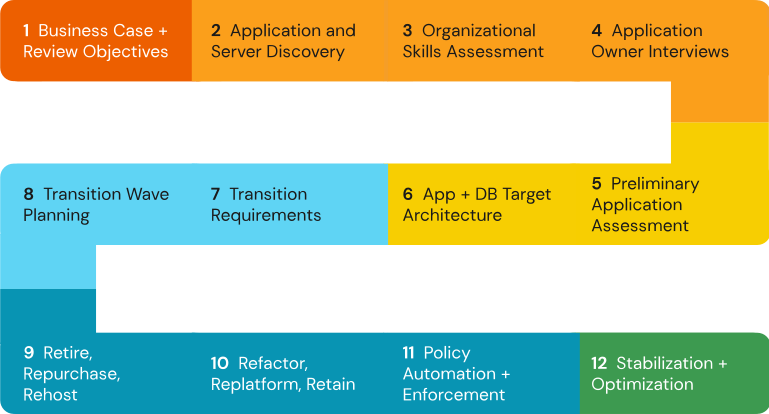
Cloud migration, modernization, AI adoption, and optimization all start the same way: understand the portfolio, gather evidence, choose the right outcome per application, fund the roadmap, and execute with clear ownership.
Modernization is a portfolio decision, not a technology purchase
Many programs start by picking a technology: a cloud platform, containers, generative AI, or a conversion tool. That creates activity without a portfolio strategy. Teams migrate what is easy instead of what creates value. They modernize where the case is weak. They adopt AI where data, controls, and operations cannot support production use.
A defensible transformation starts with the portfolio, not the technology. It asks:
- What applications do we have, and what is their business value?
- What evidence supports a change decision for each one?
- Which outcome - migration, modernization, AI adoption, replacement, retirement, or optimization - creates the most value?
- What is the dependency-aware sequence, and what foundational work enables later waves?
The technology choice follows the decision. It does not precede it.
The same evidence supports different outcomes
One application record can support decisions about cloud suitability, modernization urgency, AI readiness, replacement or retirement, and cost and operational optimization. The evidence gathered during Discover and Decide is largely common. The selected execution pattern changes during Deliver.
flowchart TD
    A[Application record with evidence] --> B{Evaluate outcomes}
    B --> C[Migrate]
    B --> D[Modernize]
    B --> E[Adopt AI]
    B --> F[Replace]
    B --> G[Retire]
    B --> H[Retain]
    B --> I[Optimize]
    C --> J[Deliver: migration]
    D --> K[Deliver: modernization]
    E --> L[Deliver: AI enablement]
    F --> M[Deliver: SaaS replacement]
    G --> N[Deliver: retirement]
    H --> O[Deliver: retain]
    I --> P[Deliver: optimization]
This is why cloud readiness, application modernization assessment, and AI readiness assessment should be treated as Decide-phase intents within one methodology - not separate exercises that reassess the same portfolio from scratch. The Cloud Readiness Assessment guide and AI Readiness Assessment cover those Decide paths on shared evidence; the Migration Playbook carries approved changes into Deliver.
Discover. Decide. Deliver.
The Tidal Enterprise Modernization Methodology™ is built on three phases.
Discover
Build a defensible understanding of the enterprise: business objectives, application portfolio, technology, dependencies, operating context, costs, risks, and constraints.
Output: Enterprise Intelligence - connected, evidence-backed business and technical context sufficient to support consequential modernization decisions. Not mere inventory.
Discover covers:
- business objectives;
- application inventory;
- dependencies and integrations;
- source code and databases;
- operating and infrastructure context;
- data sensitivity and quality;
- owner interviews;
- lifecycle, cost, performance, risk, and skills evidence.
Decide
Determine the right future for each application and the portfolio as a whole. Evaluate cloud readiness, modernization and AI opportunities, business value, risk, complexity, costs, benefits, disposition options, sequencing, waves, and target-state strategy.
Output: Transformation Strategy - dispositions, sequencing, investment case, governance, and executable roadmap.
Decide evaluates each application against possible outcomes:
- migrate;
- modernize or refactor;
- replatform;
- replace;
- retire;
- retain;
- optimize;
- adopt or enable AI.
Deliver
Execute the approved change safely, consistently, and measurably. Migration, modernization, AI adoption, replacement, retirement, and optimization are executed using appropriate practices, with governance, validation, stabilization, and continuous improvement.
Output: Measurable Business Outcomes - realized benefits, stabilized operations, and continuous improvement, not merely “apps moved.”
flowchart LR
    A[Discover<br/>Enterprise Intelligence] --> B[Decide<br/>Transformation Strategy]
    B --> C[Deliver<br/>Measurable Business Outcomes]
    C --> D[Reassess<br/>as conditions change]
    D --> A
The methodology is not linear in practice. Conditions change: costs, technology, business priorities, risks, and evidence. A defensible methodology supports continuous reassessment, not a one-time report.
What Enterprise Intelligence means
Enterprise Intelligence is the canonical output of Discover. It is connected, evidence-backed business and technical context that enables consequential decisions.
Enterprise Intelligence is more than:
- an application inventory or CMDB export;
- a dashboard or report;
- an AI-generated summary of unstructured data;
- a one-time assessment snapshot.
It is the evidence base - applications, dependencies, code, databases, costs, owners, risks, and business context - connected and maintained so that decisions can be made consistently, audited, and updated as conditions change.
Assessing modernization opportunities
A defensible assessment evaluates each application across the dimensions below. The goal is not a single score but enough evidence to choose the right outcome. Cloud migration and platform disposition questions are developed in depth in the Cloud Readiness Assessment guide.
- Business value and criticality - how important is the application, and what is the cost of downtime?
- Technical debt and lifecycle - is the platform supported, and is the codebase maintainable?
- Code and database constraints - what languages, frameworks, and data stores are in use?
- Architecture and dependencies - what does the application connect to, and what depends on it?
- Operational cost and performance - what does it cost to run, and how does it perform?
- Skills and delivery constraints - can the team operate the target state?
- Security and compliance - what are the regulatory and data constraints?
- Target-state value - what value does the chosen outcome create, and over what period?
Assessing AI readiness
AI readiness is treated as a Decide-phase intent, not a separate methodology. The same application portfolio evidence that supports migration and modernization decisions also supports AI adoption decisions.
AI readiness is grounded and application-centric:
- a suitable business use case and measurable value;
- data availability, quality, access, sensitivity, and governance;
- integration points and workflow ownership;
- application architecture and API readiness;
- model, runtime, and security constraints;
- human oversight and operational adoption;
- cost, risk, and support model.
AI readiness is not merely buying a model or a vector database. A detailed guide to assessing AI readiness across business value, use case, applications, data, platform, controls, operating model, and economics is in the AI Readiness Assessment guide.
Choosing the right outcome
A defensible assessment evaluates each application against multiple outcomes and recommends the one supported by the strongest evidence.
| Outcome | When to choose it |
|---|---|
| Migrate | Location or platform change creates sufficient value |
| Modernize | Application capability, maintainability, speed, or resilience must change |
| Adopt AI | A grounded use case, data, controls, and operating model exist |
| Replace | A commodity platform or SaaS better serves the need |
| Retire | Value no longer justifies cost and risk |
| Retain | Current state is appropriate; change is not worth the cost |
| Optimize | Current architecture is appropriate but inefficient |
The assessment should not publish proprietary scoring weights or recommendation logic. The output is a recommendation with supporting evidence, prerequisites, and a confidence level.
Build a portfolio roadmap, not a list of projects
A transformation roadmap is dependency-aware, not a list of independent projects. It balances quick wins that build confidence with foundational work that enables later waves.
- Dependency-aware sequencing - applications that share data, integrations, or platforms move together.
- Shared platforms - data, API, identity, and governance capabilities that enable multiple outcomes.
- Foundational data and API work - prerequisites for modernization and AI adoption.
- Waves - coordinated units of execution that can be planned, rehearsed, and cutover.
- Funding and governance - a funded program with owners, not a one-time project.
- Benefit realization - value is measured after delivery, not assumed.
How Tidal Accelerator operationalizes the methodology
Tidal Accelerator is Tidal’s paid Enterprise Intelligence platform. It operationalizes the Discover and Decide phases of the Tidal Enterprise Modernization Methodology™ by bringing application, infrastructure, dependency, code, database, interview, cost, and business evidence together so teams can make consistent modernization decisions across the portfolio.
Accelerator enables:
- evidence-backed assessments with provenance;
- consistent recommendations across the portfolio;
- cloud cost modelling against measured baselines;
- modernization and AI-opportunity analysis alongside migration;
- dependency-aware wave planning and roadmaps;
- executive reporting and governance artifacts;
- maintaining the assessment as evidence changes.
The methodology can be performed manually for a small portfolio. Tidal Accelerator makes it practical, repeatable, auditable, and scalable across hundreds or thousands of applications.
From decision to delivery
Once a transformation strategy is approved, the work moves to Deliver. Execution is not a collection of technical tickets. It is a coordinated business and technology change with a single execution plan, explicit ownership, tested dependencies, clear approval and backout criteria, and a controlled path into steady-state operations.
Tidal’s delivery ecosystem - Tidal Experts and consulting partners - executes the chosen outcome using proven playbook practices. The same delivery controls apply to cloud migration, application modernization, AI enablement, platform replacement, retirement, and major optimization.
The Migration Playbook and Change Management guide covers Deliver in detail: one playbook per change window, integration with formal change management, explicit success and backout criteria, roles and decision rights, rehearsals, testing and validation, stabilization and operational handoff, and continuous improvement across waves.
Proof and next step
Tidal has assessed, migrated, and modernized enterprise application portfolios across more than a decade of delivery. The proof below is drawn from real engagements across industries and regions.
Statistics Canada
A national statistics agency assessed 50 mission-critical applications in under three months and executed 37 migration waves over 18 months. Measured outcomes included 168 times faster SAS server deployment, an 87% reduction in critical job processing time, a 59% reduction in net server count, and more than $2.6M in annual cloud infrastructure cost avoidance. The program was governed with evidence-backed waves, not a one-time report. See case studies for public references.
Weedman
Weedman moved from assessment to migration to modernization in about 120 days: assessment created clarity, clarity built confidence, and confidence accelerated delivery. See case studies for public references.
Cross-industry delivery experience
Tidal has delivered migrations and modernizations across financial services, healthcare, public sector, retail, telecommunications, and utilities. Customer references and partner material are available where approved for public use. Explore the case studies for evidence across industries and regions.
Next step
The methodology is the same regardless of your starting point. The first step is always to understand your application portfolio and gather trustworthy evidence.
- Build Enterprise Intelligence with Tidal Accelerator - operationalize Discover and Decide at enterprise scale
- Assess your portfolio for cloud readiness - the Decide-phase assessment for migration and modernization
- Assess your portfolio for AI readiness - the Decide-phase assessment for AI adoption
- Deliver with a migration playbook - reliable transformation execution and change management
- Engage Tidal Experts - deliver the methodology with Tidal or a consulting partner
- Read case studies - evidence from real transformations
Frequently Asked Questions
Can't find the answer you're looking for? Reach out to our customer support team.
-
The Tidal Enterprise Modernization Methodology is Tidal’s proven, end-to-end framework for understanding an application portfolio, choosing the right transformation path, and executing change safely. It is built on three phases: Discover, Decide, and Deliver. The methodology is vendor-neutral and can be used by Tidal, consulting partners, or customer-led teams.
-
They are multiple outcomes of one methodology. Whether you intend to migrate to cloud, modernize a legacy application, adopt AI, replace a system, retire technical debt, or optimize an existing environment, the early work is substantially the same: understand the application portfolio, gather trustworthy evidence, assess opportunities, build a business case, and execute. The outcome changes; the need for Enterprise Intelligence does not.
-
Enterprise Intelligence is the canonical output of the Discover phase: connected, evidence-backed business and technical context that enables consequential modernization decisions. It is more than inventory, CMDB data, dashboards, or an AI summary. Tidal Accelerator is the paid platform that operationalizes Enterprise Intelligence across enterprise portfolios.
-
No. A defensible assessment evaluates each application against multiple outcomes and recommends the one supported by the strongest evidence. Many applications should be retained, replaced, retired, or optimized. Treating migration, modernization, or AI as the default outcome is a common reason transformation programs produce activity without value.
-
No. The methodology is vendor-neutral at the methodology level. Tidal has deep AWS alignment and partnerships, but the methodology applies to AWS, Azure, Google Cloud, and hybrid environments. Cloud-specific pathways are linked where relevant.
-
Tidal Accelerator is Tidal’s paid Enterprise Intelligence platform. It operationalizes the Discover and Decide phases by connecting application, infrastructure, dependency, code, database, interview, cost, and business evidence into Enterprise Intelligence. The methodology can be performed manually for a small portfolio; Accelerator makes it practical, repeatable, auditable, and scalable across hundreds or thousands of applications.
-
The methodology is not the software. The methodology explains what successful modernization requires. Software makes it practical, repeatable, auditable, and scalable. You can apply the methodology manually for a small portfolio, operationalize it with Tidal Accelerator at enterprise scale, or deliver it through Tidal Experts and consulting partners.
-
Yes. The methodology is designed to be used by Tidal, consulting partners, and customer-led teams. For a small portfolio, manual assessment with spreadsheets is feasible. At enterprise scale, manual approaches break down because of duplicated evidence collection, inconsistent scoring, weak provenance, and the inability to maintain the assessment as evidence changes.
Related resources
- Cloud Readiness Assessment Guide - the Decide-phase assessment for migration and modernization
- AI Readiness Assessment - the Decide-phase assessment for AI adoption
- Migration Playbook and Change Management - the Deliver-phase guide to reliable execution
- Application Modernization to AWS - AWS-specific modernization strategies and funded programs
- Digital Transformation - broader transformation beyond technology
- Tidal Accelerator - the Enterprise Intelligence platform
- Cloud Migration Strategies - migration approaches and tools
- Migration Planning - wave planning and roadmap development
- Case Studies - customer evidence across industries