

Managing DHCP across distributed networks gets messy fast.
Lease activity changes constantly. Naming conventions drift. Infrastructure changes happen independently across locations. Before long, your team no longer has a complete view of what’s happening across the network.
What started as a straightforward service becomes a records problem with real operational consequences.
(Need a refresher on the new LightMesh DHCP integration? Read: LightMesh DHCP Integration: Always Know What’s on Your Network)
When DHCP Records Become Hard to Trust
In distributed networks, the challenge isn’t collecting DHCP data - it’s maintaining confidence in it.
Large distributed networks often face:
- Separate DHCP server ownership
- Regional naming differences
- Independent site changes
- Limited cross-site DHCP visibility
Over time, those differences accumulate. Simple questions - who had this IP, where did the lease originate, when did the assignment change - require searching multiple systems before the investigation can even begin.
Managing DHCP Across Teams, Sites, and Servers
Teams spend more time reconciling DHCP activity than acting on it. Incident response slows down, infrastructure changes become harder to validate, and onboarding new locations often means recreating scope structures that should already exist.
LightMesh brings DHCP activity, lease history, and IP inventory together in a single operational workflow, reducing the need to jump between systems during day-to-day operations. When new DHCP scopes are discovered without existing parent infrastructure mappings, LightMesh can automatically create the associated subnet and zone structures, helping your team maintain consistent records across locations without manual cleanup or rework.
(For more on how the Windows Discovery Agent continuously synchronizes DHCP activity into LightMesh, read: Centralize DHCP Visibility with the Windows Discovery Agent)
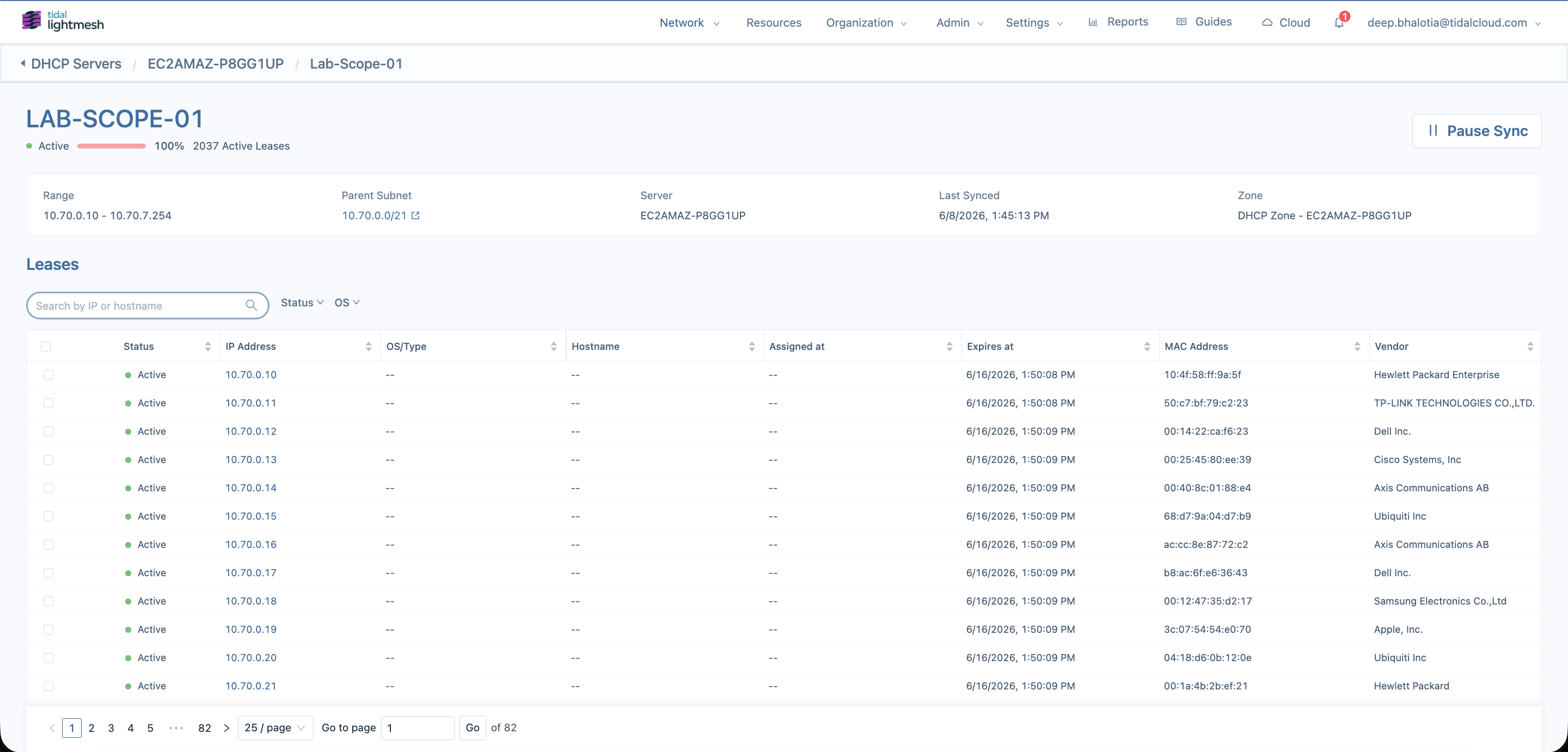
DHCP scope showing lease activity, utilization, and the most recent synchronization.
When the History Is the Whole Investigation
In high-volume networks, small inconsistencies compound quickly. A subnet fills unexpectedly. A device reconnects from a different location. An IP changes ownership mid-incident.
In those moments, the question isn’t just what’s assigned right now - it’s what changed, when it changed, and which device was involved. With accurate lease history in LightMesh, your team can focus on resolving the issue rather than reconstructing it.
Built for High-Volume DHCP Environments
LightMesh synchronizes tens of thousands of lease updates across distributed infrastructure, supporting both Windows Server and Windows Server Core deployments through the Windows Discovery Agent. That gives you a single, auditable view of IP assignment activity across DHCP, datacenter infrastructure, and cloud platforms like AWS and Azure.
One LightMesh customer already manages more than 30,000 active IPs. At that scale, maintaining reliable DHCP records manually across multiple systems and locations simply isn’t practical. LightMesh gives your team one place to see lease activity, validate assignments, and trust the records behind every operational decision.
Keep DHCP Records Reliable as You Grow
The real challenge isn’t assigning IP addresses. It’s maintaining infrastructure records you can trust as your network continues to grow.
LightMesh helps you keep DHCP activity, lease history, and IPAM records aligned—so you spend less time reconciling data and more time managing your network with confidence.
For a complete walkthrough of moving from a legacy IPAM to LightMesh, including DHCP and Azure or AWS integration, see our step-by-step migration guide.
See DHCP visibility in LightMesh. Start free — 14 days of expanded access, then the Free plan.