

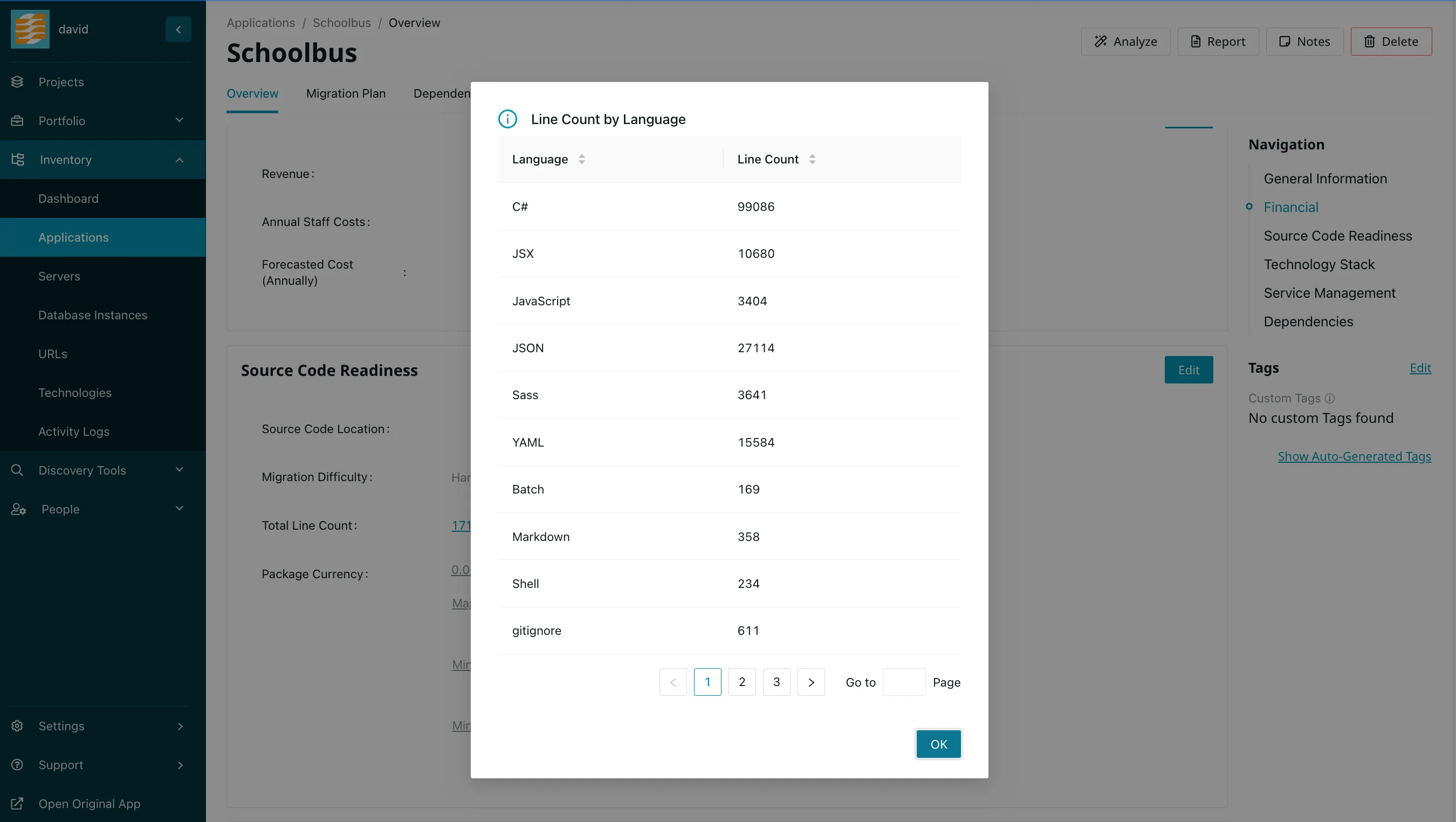
Code-Level Migration Assessment for AWS
Infrastructure assessment tools scan your servers and estimate migration cost based on CPU, memory, and storage.
They do not read your application code.
Applications that appear migration-ready at the infrastructure layer may contain thousands of lines of code that block cloud adoption. Without code-level visibility, teams cannot make accurate 6R decisions.
The Problem: Infrastructure-Only Tools Miss Code Complexity
Traditional migration tools analyze VMs and databases. They count cores and allocate cloud instances. They do not read your application code.
Code complexity determines migration effort.
A Java application running on a standard 4-core VM may require hundreds of hours of refactoring to run in AWS Lambda. A .NET application on identical hardware may need minimal changes for EC2. Infrastructure metrics cannot distinguish them.
The result: budgets that assume lift-and-shift, timelines that ignore refactoring requirements, and migrations that stall when code issues surface mid-project.
The Observation: Code-Level Analysis Identifies Modernization Opportunities
Source code analysis reveals what infrastructure scans cannot see.
Static analysis identifies cloud blockers before migration planning:
- Framework versions that lack cloud-native equivalents
- Deprecated APIs incompatible with containerized environments
- Database query patterns that fail at cloud scale
- Hardcoded configurations requiring environment abstraction
- Security vulnerabilities that block compliance
Illustrative findings from representative assessments:
| Finding | Business Impact |
|---|---|
| 47 hardcoded database connection strings | Requires configuration management rewrite |
| 12 EJB 2.x session beans | Blocks serverless migration path |
| 3,400 synchronous blocking calls | Lambda timeout risk |
| Deprecated authentication library | Security compliance failure |
| 89 non-parameterized SQL queries | RDS performance and security issues |
These findings enable data-driven pathway decisions. They complement application portfolio assessment by exposing logic-level blockers infrastructure scans miss.
The Recommendation: Use Source Code Analysis for 6R Decisions
The 6R framework (Rehost, Replatform, Refactor, Repurchase, Retain, Retire) requires application-level analysis.
Code analysis enables pathway selection based on evidence:
Rehost: Applications with low code complexity and minimal dependencies. Clean separation of concerns. Standard frameworks with cloud-compatible versions.
Replatform: Applications requiring framework upgrades or database migrations. Moderate refactoring needs (20-200 hours). Clear containerization path.
Refactor: Applications with significant architectural debt. Heavy refactoring requirements (200+ hours). Microservice decomposition candidates.
Repurchase: Applications where refactoring cost exceeds SaaS replacement. High custom code volume with available commercial alternatives.
Retain: Applications with no near-term migration trigger, or where code modernization must wait for a dependent system to move first.
Retire: Applications with unused code paths, duplicate functionality, or no active users — candidates to decommission before migration spend.
Without code analysis, teams default to Rehost for everything. This defers complexity and increases long-term cost.
Tidal Accelerator integrates source code assessment into the discovery process. Upload codebases for static analysis and receive modernization scores aligned to the 6R framework.
The Cost: Early Modernization Saves vs Later Refactoring
Migration timing impacts cost structure.
Addressing code issues before migration:
- Uses existing budget and team capacity
- Prevents production issues in cloud environments
- Enables cloud-native feature adoption immediately
- Reduces technical debt accumulation
Deferring code issues until post-migration:
- Requires dual-environment maintenance
- Introduces production downtime risk
- Increases cost due to change control overhead
- Delays cloud cost optimization
In one illustrative enterprise Java assessment, pre-migration analysis identified roughly 340 hours of required refactoring. The same scope estimated post-migration approached 1,200 hours once integration dependencies and production change controls were included — a material increase in deferred technical debt.
The Risk: Migrating Without Code Review Creates Technical Debt
Applications migrated without code assessment carry invisible risk.
Operational risk: Hardcoded timeouts fail under cloud load. Synchronous calls block auto-scaling. Security vulnerabilities pass compliance scans.
Financial risk: Applications moved to oversized instances due to unknown performance characteristics. Rightsizing deferred until code behavior is understood.
Strategic risk: Applications migrated to EC2 that should have been serverless. Cloud-native features unavailable due to framework limitations. Competitive disadvantage from technical debt.
Code review before migration reduces these risks to measurable decisions.
Summary
Infrastructure assessment alone cannot support accurate AWS migration planning. Source code analysis exposes blockers, supports all six 6R pathways, and reduces cost and risk when run before migration execution.
Pair code-level assessment with application portfolio analysis and AWS Transform during MAP Phase 1 for a complete assessment foundation.
Next Step: Start your complete MAP Phase 1 assessment
Tidal Accelerator provides source code analysis for AWS migration assessments. Analyze Java, C#, Python, JavaScript, PHP, and other supported languages. Identify modernization pathways based on actual code structure, not infrastructure assumptions.